India Chair on Artificial Intelligence to be established at Slovak university, says PM Narendra Modi


India Chair on Artificial Intelligence to be established at Slovak university, says PM Narendra Modi
PM Narendra Modi highlights ethical AI as India announces academic collaboration with Slovakia

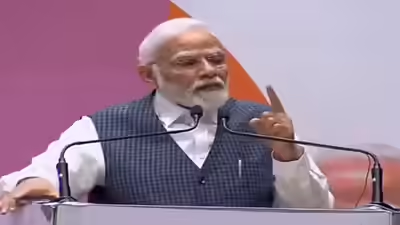
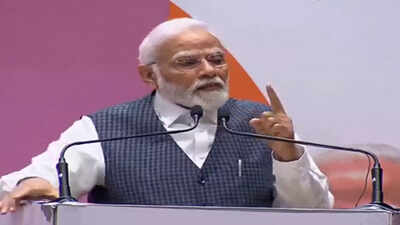
Prime Minister Narendra Modi has announced the establishment of an India Chair on Artificial Intelligence (AI) at a university in Slovakia, calling it a significant step towards strengthening international collaboration in emerging technologies.In a statement shared on social media, the Prime Minister welcomed the initiative and said that AI should serve humanity and become a strong medium for progress and public good. He emphasized that India’s approach to AI is rooted not only in innovation, but also in trust, responsibility, and human dignity.The announcement reflects India’s growing engagement with global academic institutions to shape the future of AI governance, research, and ethical development. The proposed India Chair is expected to promote joint studies, academic exchange, and collaborative research between Indian and Slovak institutions in the field of artificial intelligence.Focus on ethical and human-centric AI developmentHighlighting India’s vision for technology, the Prime Minister reiterated that the future of AI must go beyond technological advancement and be anchored in ethical principles. He said that innovation must be guided by responsibility and a commitment to human welfare.The initiative aligns with India’s broader digital strategy, which promotes the use of AI in sectors such as healthcare, education, agriculture, governance, and skill development, while ensuring safeguards around transparency and accountability.Officials noted that such academic collaborations are crucial for building a global framework for responsible AI development, especially as countries increasingly adopt artificial intelligence in critical decision-making systems.Strengthening India’s global academic footprintThe establishment of the India Chair in Slovakia is also seen as part of India’s efforts to expand its academic and research footprint internationally. Through such partnerships, India aims to contribute to global knowledge systems while also learning from advanced research ecosystems abroad.The move is expected to facilitate faculty exchange, joint research projects, and student engagement programmes between Indian and Slovak institutions. It also reinforces India’s positioning as a key voice in global discussions on ethical and inclusive AI development.Experts believe that initiatives like this will play an important role in shaping international norms for artificial intelligence, particularly at a time when AI technologies are rapidly transforming economies and societies worldwide.The announcement has been welcomed as a step forward in strengthening academic diplomacy and deepening India’s role in global technology governance.


Source link

From celebrity child to chess mentor: How Allu Arjun’s daughter Allu Arha entered a World Records Book at just five


From celebrity child to chess mentor: How Allu Arjun's daughter Allu Arha entered a World Records Book at just five
While most children her age are only beginning to explore new skills, Arha achieved a feat that captured global attention. The five-year-old trained 50 chess learners and solved 30 puzzles simultaneously, earning recognition in the Noble Book of World Records. Her journey underscores how chess can nurture leadership, critical thinking, and confidence from an early age.

Most five-year-olds are busy learning the alphabet, making new friends in school, or figuring out how to ride a bicycle without training wheels. Arha, however, was doing something few children her age could even imagine, teaching chess to dozens of students and earning a place in the Noble Book of World Records.The daughter of actor Allu Arjun may have been born into one of India’s most recognisable film families, but her entry into the record books had nothing to do with cinema. It came from a chessboard.At just five years old, Arha was recognised as one of the world’s youngest chess trainers after she trained 50 students and simultaneously solved 30 chess puzzles. It was an achievement that demanded not only an understanding of the game but also the ability to explain it to others, something many adults struggle to do.

A childhood achievement that went beyond winning

In an age where children’s accomplishments are often measured through examination scores and competition trophies, Arha’s record stands out for a different reason. It was rooted in learning and teaching.Chess cannot just be regarded as a game played by kings and queens on 64 squares. It has been used in education as an essential way of promoting concentration, memory, strategy, patience, and decision-making for many years now. Teaching chess demands that one should be more knowledgeable about it since he or she will need to explain things clearly.It takes a lot to teach chess to 50 learners at the same time and this is what makes the achievement more exceptional.

The noble book of World Records recognition

The award for “Noble Book of World Records” turned her childhood passion into a true accomplishment in terms of education. In addition, there is a trend emerging – talent becomes apparent far earlier than expected.In contrast to many other records which are all about speed or some kind of endurance or extraordinary ability, Arha’s record had everything to do with her brain and the sharing of knowledge.

Stepping out of a famous shadow

While celebrity children frequently attract attention because of their famous surnames, Arha’s journey offers a refreshing counter-narrative. Her achievement was earned across a chessboard, not a film set. That is perhaps why the story continues to resonate.

Why chess continues to matter in education

Educators across the world increasingly recognise chess as more than an extracurricular activity. Studies have often linked the game with improved analytical thinking, problem-solving skills, and concentration among young learners.Arha’s achievement shines a spotlight on the educational value of the game and the possibilities that emerge when children are encouraged to pursue interests beyond conventional classroom learning.Her story also challenges common assumptions about age and capability. It suggests that when talent is nurtured early, children can achieve outcomes that many adults might consider extraordinary.

A lesson for young learners everywhere

For parents, teachers, and students, Arha’s journey carries an important lesson. Excellence is not always about age. Sometimes it is about passion meeting opportunity.At five, Arha was not simply learning chess. She was teaching it, inspiring others, and building a record-breaking achievement that would place her among an extraordinary group of young achievers.In a world increasingly obsessed with instant fame, her story is a reminder that some of the most meaningful accomplishments begin with a child, a classroom, and a chessboard.


Source link

NEET UG 2026: NTA announces post-exam refund correction facility for banking errors


NEET UG 2026: NTA announces post-exam refund correction facility for banking errors
The National Testing Agency has announced a post-examination correction facility for NEET UG 2026 candidates to update incorrect bank account details linked to fee refunds. The move comes as the agency begins processing refunds following the cancellation of the earlier exam and warns aspirants against refund-related fraud attempts.

The National Testing Agency (NTA) has announced that candidates appearing for the NEET UG 2026 re-examination will receive another opportunity to correct or update their bank account details for fee refunds after the examination. The move comes as the agency begins refunding examination fees following the cancellation of the earlier NEET UG 2026 test conducted on May 3.According to NTA, all refunds will be transferred directly to the bank accounts submitted by candidates through the official portal. To avoid delays in receiving the refund amount, students have been advised to carefully verify their account details, including the account number, IFSC code and account holder’s name, before downloading their admit cards.

Fresh relief for candidates

The agency clarified that some candidates may have entered incorrect banking information or faced difficulties during the verification process. To address these concerns, NTA said a separate correction window will be opened after the examination, allowing students to update or rectify their bank account details required for the refund process.The announcement is expected to provide relief to thousands of candidates who were worried that errors in their submitted details could affect the refund of examination fees.

How candidates can verify details

To review their banking information, candidates need to log in to the NEET UG portal using their application number and password or date of birth. After accessing the bank account verification section, they can check the details entered and make necessary corrections before saving and submitting the information.NTA has urged candidates to ensure that all information is accurate so that refunds can be processed smoothly and without unnecessary delays.

NTA warns against fraud attempts

Alongside the refund process, NTA has issued a strong warning about fraudsters attempting to exploit candidates. The agency advised students not to trust phone calls, messages, emails or links claiming to facilitate or expedite refunds.NTA reiterated that it never asks candidates for OTPs, passwords, UPI PINs or any payment for processing refunds. Students have been urged to remain vigilant and rely only on official communications issued through the agency’s website.

Refund process underway

The refund exercise is being carried out simultaneously with preparations for the NEET UG 2026 re-examination. NTA has indicated that additional information regarding the post-examination correction facility for bank account details will be released through official channels in the coming days.

How confident are you in the refund process being handled by NTA?

For now, candidates have been advised to regularly monitor official announcements and ensure that their submitted banking information is correct to avoid complications during the refund process.


Source link

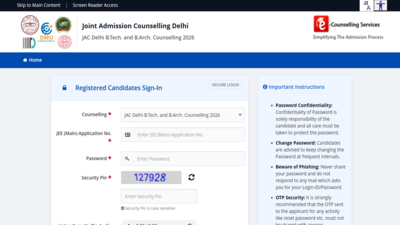
JAC Delhi round 1 seat allotment 2026 released at jacdelhi.admissions.nic.in: Direct link to download here


JAC Delhi round 1 seat allotment 2026 released at jacdelhi.admissions.nic.in: Direct link to download here
The Joint Admission Committee (JAC), Delhi, has announced the Round 1 seat allotment result for 2026 counselling after 5 PM on June 15. Candidates can access their allotment status on the official portal using JEE Main login credentials. The result reflects institute and branch allocation based on merit, preferences, category, and seat availability.

Joint Admission Committee (JAC), Delhi has announced the Round 1 seat allocation result for admissions to B.Tech and B.Arch programs for June 15, 2026. Students can check their seat allotment through the JAC portal using the application number and password obtained during the counselling registration process.For those who attended the counselling process, they need to visit the JAC portal and check their seat allotment status from their account logins. The allotment letter provides information about the institute and course allotted based on: JEE Main rank, category, preference filling during counselling, and availability of seats in various categories. It is necessary for the candidates to visit the allotted college within the time frame specified.

Top institutes under JAC Delhi counselling

The JAC Delhi counselling process manages admissions to four major technical institutes in the capital:

  • Delhi Technological University
  • Netaji Subhas University of Technology
  • Indira Gandhi Delhi Technical University for Women
  • Indraprastha Institute of Information Technology Delhi

What happens after Round 1 allotment

Candidates who are satisfied with their allotted seat must complete the admission process by visiting the institute and submitting required documents within the deadline.However, students who wish to upgrade their allotment or did not receive their preferred branch still have multiple opportunities ahead. JAC Delhi will conduct:

  • Round 2 counselling
  • Round 3 and Round 4 allotments
  • Upgradation rounds
  • Spot admission rounds for vacant seats

JAC Round 1 counselling 2026: Steps to download seat allotment result

Candidates should consider the following procedure for downloading their JAC Round 1 seat allotment result:

  • Go to the official JAC Delhi website: https://jacdelhi.admissions.nic.in
  • Click on the option of “Round 1 Seat Allotment Result 2026”
  • Login through JEE Main 2026 application number and password
  • Find out your allotted institute, programme and category information
  • Download and preserve the seat allotment letter received provisionally
  • Make hard copies for admission purpose
  • Appear at the allotted institute on or before deadline
  • Conduct your document verification process
  • Make payment of the requisite fees
  • Appear in other rounds if you are not satisfied with your allotment

Candidates can go to the link given below to download their JAC Round 1 seat allotment result 2026.Alternatively, candidates can click on the link provided here to download the JAC Round 1 seat allotment result 2026.


Source link

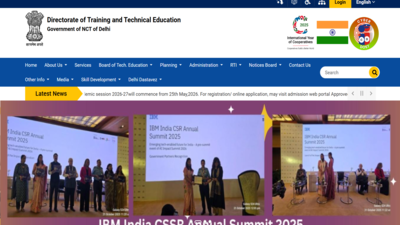
Delhi CET result 2026 declared at tte.delhi.gov.in: Direct link to download here


Delhi CET result 2026 declared at tte.delhi.gov.in: Direct link to download here
The DTTE Delhi has announced the CET 2026 results on its official portal, activating the admission process for diploma courses across the capital. Candidates can now download scorecards to check marks and ranks, which will determine counselling eligibility. The process has entered a critical phase with registration, choice filling, and seat allotment scheduled in structured rounds ahead.

The Directorate of Training and Technical Education (DTTE), Delhi, has officially released the Delhi CET 2026 result, on the official website, tte.delhi.gov.in. Candidates who appeared for the Delhi CET 2026 examination can now download their scorecards using their login credentials. The result includes subject-wise marks, total score, and overall rank, which will serve as the sole basis for counselling and admission.With the result out, the counselling cycle has officially been set in motion. Registration and choice filling begin immediately after the declaration, leaving candidates with a narrow window to strategise their preferences.The process will move through structured stages:

  • Online registration and choice filling
  • Mock or initial seat allotment rounds
  • Final seat allocation based on merit and availability
  • Reporting and document verification at allotted institutes

Authorities have made it clear that missing deadlines at any stage will lead to cancellation of candidature for that round.

Delhi CET result 2026: Steps to download

Candidates can follow the steps elucidated here to download the Delhi CET result 2026 from the official website:

  • Go to the official website of DTTE Delhi CET portal, tte.delhi.gov.in
  • Click on the link that says “Delhi CET 2026 Result” or “Scorecard Login”
  • Enter your application number/roll number and password or date of birth
  • Submit the details to proceed
  • The Delhi CET 2026 scorecard will appear on the screen
  • Check your marks, rank, and personal details carefully
  • Download the result and take a printout for counselling and admission use

Alternatively, candidates can click on the link provided here to download the Delhi CET result 2026.

Counselling decides fate of thousands of aspirants

Delhi CET is the entry gate to diploma-level technical education in Delhi’s government and affiliated institutes. With seats limited and demand consistently high, counselling is not a formality—it is a high-pressure allocation process driven strictly by merit and preference order.Candidates will be required to:

  • Lock choices carefully during counselling
  • Track seat allotment results closely
  • Confirm admission within deadlines
  • Complete verification at allotted colleges

Any lapse in compliance can result in immediate loss of seat, regardless of rank.


Source link

SSC GD Constable provisional answer key 2026 released at ssc.gov.in: Direct link to download here


SSC GD Constable provisional answer key 2026 released at ssc.gov.in: Direct link to download here
The Staff Selection Commission has published the SSC GD Constable provisional answer key 2026 on its official portal, bringing relief to candidates who appeared for the recruitment exam. Conducted between April 27 and May 30 for 25,487 posts, the exam response sheets are now available online. Applicants can log in to ssc.gov.in to check answers, estimate scores, and raise objections if needed.

The Staff Selection Commission has released the SSC GD Constable provisional answer key 2026 on its official website, ssc.gov.in. Candidates who appeared for the recruitment exam can now check their response sheets and calculate their expected scores.The answer key has brought clarity after weeks of uncertainty following the written examination for 25,487 vacancies. The SSC GD Constable written examination was held from April 27 to May 30 in multiple shifts across the country. The exam is the first and most important stage of the selection process for General Duty Constable recruitment.

SSC GD Constable answer key 2026: Steps to download

Candidates can follow the steps elucidated here to download the SSC GD Constable answer key 2026 from the official website:

  • Go to the official SSC website, ssc.gov.in.
  • On the homepage, search and click on the “Answer Key” section.
  • Open the SSC GD Constable Answer Key 2026 link
  • Enter registration number and password
  • Fill in the captcha code
  • Submit and download the response sheet

Alternatively, candidates can click on the link provided here to download the SSC GD Constable answer key 2026.The provisional answer key is not final. SSC has also opened an objection window for candidates. If a candidate finds any discrepancy in the answers, they can raise objections by paying a nominal fee per question. If the objection is accepted after expert review, the fee is refunded.Candidates are advised to stay tuned to the official website to get the complete details of the SSC GD answer key 2026.


Source link

CBSE CTET correction window 2026 opens at ctet.nic.in: Check link to edit here


CBSE CTET correction window 2026 opens at ctet.nic.in: Check link to edit here
The CTET September 2026 application correction window has been activated by the Central Board of Secondary Education, enabling candidates to modify specific details in their submitted forms through ctet.nic.in. Access is available via login credentials, but only limited fields can be edited. The board has warned that no changes will be allowed after the deadline.

CBSE CTET correction window 2026: The Central Board of Secondary Education (CBSE) has now activated the application correction facility for the CTET September 2026 session. This service is restricted to the applicants alone who have completed the process of filling up their application form successfully. It should be mentioned here that the correction facility will have a strict time limit, beyond which no further modifications will be possible.Now, the correction facility has been enabled for the CTET September 2026 session on the official website itself. To access your application form online, you need to use your application number and password to enter the system. You should also know that the modification of application can be done only in those fields that are specifically allowed by the CBSE.

CBSE CTET correction window 2026: Steps to edit

Candidates must follow the steps elucidated here to edit the CBSE CTET correction form 2026:

  • Go to the official website ctet.nic.in
  • Select the “CTET September 2026 correction window” option
  • Log into your account using the application number and password
  • Edit the necessary parts in the application form
  • Review the edited information before submission
  • Click submit
  • Save the confirmation page downloaded

Alternatively, candidates can click on the link provided here to download the CTET CBSE correction window 2026.Aspirants are advised to stay tuned to the official website to get the complete details of the CBSE CTET correction window 2026.


Source link

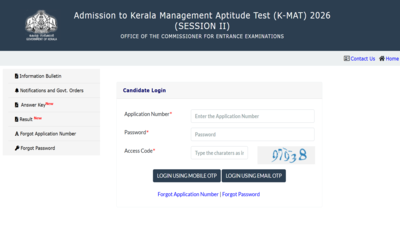
KMAT Kerala Session 2 result 2026 declared at cee.kerala.gov.in: Direct link to download scorecards


KMAT Kerala Session 2 result 2026 declared at cee.kerala.gov.in: Direct link to download scorecards
The KMAT Kerala Session 2 Result 2026 has been released by the CEE Kerala on its official portal, recording an impressive 99.31% qualification rate. Aboobackar P S secured the top position in the merit list. Candidates who appeared for the MBA entrance exam can now access and download their scorecards for the next admission stages.

The Office of the Commissioner for Entrance Examinations (CEE), Kerala, has announced the KMAT Kerala Session 2 Result 2026 through its official website, cee.kerala.gov.in. According to the official result details, out of 3,628 students appearing for the exam, 3,603 have qualified, while only a few remain ineligible. The results have been published in the form of a merit list containing application numbers and candidate names, among other details.KMAT Kerala 2026 result card features the following details:• Candidate’s name and application number• Mark distribution in various sections• Total marks obtained and percentile• Whether or not the candidate qualifies• Merit list position, if anyKMAT eligibility requirements include securing the cut-off marks as prescribed by the board of CEE, Kerala. Though general category students have to meet the minimum cut-off, reserved categories have a more flexible approach. Students securing the required cut-off marks will be eligible to appear on the merit list.

KMAT result 2026: Steps to download scorecards

Candidates can follow the steps elucidated here to download the KMAT result 2026 from the official website:

  • Go to the official CEE Kerala website: cee.kerala.gov.in
  • Click on the “KMAT 2026 Session 2 Result” link
  • Enter application number and password/date of birth
  • Submit login details
  • Download and print the scorecard for future use

Alternatively, candidates can click on the link provided here to download the KMAT result 2026.

What happens next after result declaration

With the declaration of results, the admission process for MBA programmes across participating institutions in Kerala will now move to the next stage. Qualified candidates will be called for counselling and seat allotment based on their rank and preferences.Final admission will depend on KMAT scores along with subsequent selection procedures conducted by respective institutions.


Source link

SAT 2026–27 cycle opens: College Board releases full test schedule, Registration begins for global admissions race


SAT 2026–27 cycle opens: College Board releases full test schedule, Registration begins for global admissions race
The College Board has released the SAT 2026–27 schedule, with exams from August 2026 to June 2027. Registration for the first test closes on August 7, 2026, as students prepare for global undergraduate admissions.

The College Board has officially opened registrations for the SAT 2026–27 testing cycle, setting the stage for another busy admission season for students aiming to study abroad. The new schedule, running from August 2026 to June 2027, comes at a crucial time when students across India and South Asia are preparing for undergraduate applications to global universities.

First SAT of the cycle on August 22, 2026

The first SAT of the 2026–27 cycle will be conducted on August 22, 2026. Students planning to appear in this exam must complete their registration carefully within the given timeline.

  • Registration deadline: August 7, 2026
  • Late registration and changes deadline: August 11, 2026

Authorities have advised students not to wait until the last moment, as test centre availability may vary across regions.

Full SAT 2026–27 test dates

The complete schedule includes seven test dates spread across the academic year:

  • August 22, 2026
  • September 12, 2026
  • October 3, 2026
  • November 7, 2026
  • December 5, 2026
  • March 6, 2027
  • May 1, 2027
  • June 5, 2027

Digital SAT format and exam experience

The SAT continues to be conducted in a fully digital format through the Bluebook application. The shift is aimed at making the exam more flexible and aligned with modern learning patterns.Students who are unable to use a personal device due to unavailability may seek assistance from the College Board Device Lending Programme on condition that the application is made within 30 days of the examination.

Proper SAT cycle approach by students

As a result of various testing opportunities offered in 2026 and 2027, there will be an opportunity to resit exams in order to get better results. According to experts, students need to synchronize their SAT tests with the deadlines of the university where the student would like to apply.Early months of the cycle, particularly from August to December 2026, might be quite important for students seeking to apply in the early admission period.


Source link

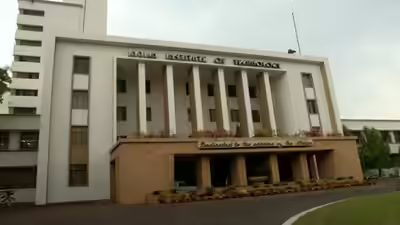
IIT Kharagpur–IIPH Delhi extends MPH (Health Science & Technology) admissions deadline: Check details here

The Indian Institute of Technology (IIT) Kharagpur, in collaboration with the Indian Institute of Public Health (IIPH)-Delhi, has extended the application deadline for its Master of Public Health (Health Science & Technology) programme. Candidates can now apply till 21 June 2026, for the academic session beginning July 2026.The two-year full-time postgraduate programme is offered through IIT Kharagpur’s Dr. B. C. Roy Multi-Speciality Medical Research Centre in partnership with IIPH-Delhi.

A programme designed around Health, Data and Technology

The MPH (Health Science & Technology) course has been structured to combine public health education with technology-driven approaches. The institutions aim to prepare professionals who can respond to complex health challenges using data, research tools, and policy understanding.The curriculum includes core subjects such as epidemiology, biostatistics, health systems, health economics, social determinants of health, environmental and occupational health, and maternal and child health.Alongside traditional public health training, students will also be introduced to programming, AI/ML applications, and digital health systems, reflecting the increasing role of technology in healthcare delivery and research.Electives expand the academic scope further into areas like disaster management, infectious and non-communicable disease epidemiology, health technology assessment, pharmaceutical policy, and behavioural health sciences.

Focus on building a skilled public health workforce

According to the institutions, the Programme has been designed in response to the growing need for trained public health professionals in India. The emphasis is on strengthening systems that support Universal Health Care and Sustainable Development Goals, while also aligning with national policy frameworks such as NEP 2020 and Digital India.The objective is to train professionals who can move beyond classroom learning and contribute directly to policy, research, healthcare systems, and development programmes.The programme also stresses equity in health, preparing students to work with vulnerable and underserved populations across diverse social and economic settings.

Who can apply: Wide eligibility across disciplines

Eligibility for the programme is kept broad to include both medical and non-medical backgrounds. Applicants must have Mathematics at the 10+2 level and meet one of the following conditions:Graduates in medical and allied fields such as MBBS, BDS, BAMS, BHMS, BNYS, BUMS, BSMS, Nursing, Physiotherapy, Occupational Therapy, Pharmacy, or B.Tech/BE (any branch)OR a 4-year degree in disciplines such as Statistics, Sociology, Economics, Psychology, Nutrition, Social Work, Management, Law, Anthropology, and related fieldsOR a graduate degree in any discipline along with a postgraduate qualification in approved social science or health-related subjects.

Admission process involves test and interview

The selection process begins with an online application, which includes academic documents, work experience details, and a Statement of Purpose (SOP).Shortlisted candidates will be called for an objective-type entrance examination, to be held in Delhi or Kolkata. Those who qualify the test will proceed to an interview round.Final admission will be based on a combined score of the entrance test and interview, with equal weightage given to both stages.

Two-year structure split between Delhi and IIT Kharagpur

The MPH-HST programme runs for four semesters over two years.

  • First two semesters: IIPH-Delhi, focusing on classroom teaching, tutorials, and practical sessions
  • Third semester: IIT Kharagpur, with advanced academic training
  • Fourth semester: Dissertation and project work, lasting six months

Students will also undergo internships in hospitals, NGOs, research organisations, laboratories, or community health settings.The course will be delivered in English and includes hands-on training in data analysis tools, software applications, and field-based public health work.

More 

Fees, accommodation and scholarship support

The programme fee is ₹1,50,000 per semester, payable separately to the respective institute.Accommodation is not included in the fee:

  • IIPH-Delhi does not offer hostel facilities, so students must arrange their own stay
  • IIT Kharagpur provides hostel accommodation, but students must pay additional charges for lodging and meals

A limited number of merit-based scholarships may be awarded, depending on availability of funds.

Source link