WBJEE 2026 results today at 1.30 pm— see direct links to check rank card and final answer key


WBJEE 2026 results today at 1.30 pm— see direct links to check rank card and final answer key
Screengrab: WBJEE website

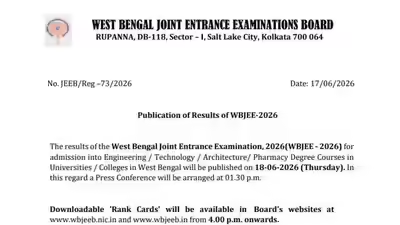
West Bengal Joint Entrance Examinations Board (WBJEEB) is releasing the result today at 1.30 pm and the rank card at 4 pm. A press conference has been scheduled for 1.30 pm. Earlier today, the board released the final answer key.In the final answer key notice, the board stated that one question in the Physics and Chemistry paper was withdrawn. It clarified that marks for the withdrawn question will be awarded to all candidates who appeared for the examination.According to an official notice issued on June 17, scoring and ranking for WBJEE 2026 will be prepared on the basis of the final answer keys after reviewing challenges submitted earlier by candidates and carrying out internal verification.WBJEE is a state-level entrance examination conducted for admission to undergraduate Engineering, Technology, Pharmacy and Architecture courses offered by universities, government colleges and private institutes across West Bengal.

How to download WBJEE 2026 result and rank card

Students can follow the below steps to check their results and rank cards:

How to download WBJEE 2026 final answer key

  • Visit the official WBJEEB website
  • Look for the WBJEE 2026 final answer key notice
  • Open the PDF link available on the homepage
  • Check the final answers for Mathematics, Physics and Chemistry
  • Download and save the PDF for reference
  • Compare the answers with your responses if required

Here’s the direct link to the answer key


Source link

Jumped from ₹10 lakh to ₹80 lakh in just one year: Here’s why Ritu Maurya’s 5-step job-hunting strategy is going viral


Jumped from ₹10 lakh to ₹80 lakh in just one year: Here's why Ritu Maurya's 5-step job-hunting strategy is going viral
A software engineer’s remarkable salary jump has sparked widespread interest online. Ritu Maurya says her success came from building real-world projects tailored to target roles, leveraging AI tools, and reaching out directly to hiring managers. Her five-step approach offers a fresh perspective on standing out in an increasingly competitive job market.

Are you not the one who keeps scrolling on LinkedIn to get that one suitable job with obviously a hefty package? It is always a hush-hush act of employees as soon as they step out of the threshold of the office doors. But aren’t we following the same old recipe and expecting a different dish? A recent social media clip by Ritu Maurya addresses the same concern. She has spilled the beans about her jump to an 80 LPA salary from 10 LPA, and honestly, it’s no joke. According to Maurya, the breakthrough did not come from sending hundreds of résumés. Instead, she credits a strategy built around demonstrating skills before an interview ever begins.We are in an age of artificial intelligence that is remolding recruitment, and applicants often compete with hundreds of candidates for a single opening. A resume definitely holds value, but it is no longer the ultimate mantra to success. Through a widely shared Instagram post, Maurya outlined a five-step framework that she says helped transform her career trajectory. The approach combines AI tools, project-building, personal branding, and direct engagement with recruiters and hiring managers. Her message is simple: candidates should not wait for an interview to prove their worth.

Start with the role you want

The first step, according to Maurya, is identifying a company that genuinely aligns with one’s professional aspirations. Rather than limiting the search to organisations that are actively recruiting, she encourages candidates to study real job descriptions that reflect the roles they hope to secure in the future. The purpose is not to apply immediately but to understand what employers are looking for.Job descriptions, she argues, offer valuable insights into the skills, qualifications, and problem-solving abilities companies value most. By analysing these requirements, candidates can gain a clearer picture of the capabilities they need to develop.

Turning AI into a career coach

Maurya’s strategy then moves to a tool that has rapidly become part of many professionals’ workflows: ChatGPT. She advises candidates to paste a target job description into the AI assistant and use it to generate a project idea relevant to the role. Rather than creating generic portfolio pieces, the objective is to build something directly connected to the challenges and responsibilities outlined in the position.It will, therefore, change how AI is used, changing it from being just a means of generating content to becoming a personal coach in career development.The project that is generated acts as concrete proof of a candidate’s understanding of what the industry needs as well as his ability to solve the challenge at hand.

Building without having advanced programming knowledge

One of the aspects about Maurya’s process that stands out is her focus on making things accessible for people who don’t have advanced programming experience. For example, Maurya suggests that candidates use Emergent.sh, an AI development platform that helps people plan, code, debug, and deploy projects.Candidates can, therefore, develop functional prototypes even when they lack the technical know-how. However, Maurya warns against considering the prototype as the finished product.“The first version is a draft,” Maurya noted, encouraging users to continuously refine their work through multiple rounds of feedback and improvements. The goal is to create something genuinely useful rather than merely completing an exercise.

Solving problems before being hired

One of the most notable aspects of Maurya’s advice comes after the project is finished. Rather than waiting for a recruiter to find her online portfolio, she advises the proactive step of contacting the hiring manager and showing off the results. The letter she suggests includes identifying an issue that the company is facing and a project tailored to solving it.This process is akin to a mini case study in the job application.It makes sense that hiring managers faced with countless résumés would take notice of candidates who have put time into identifying business problems and solving them.

The LinkedIn multiplier

Another important aspect that Maurya highlights is public exposure. In her opinion, upon completion of a project, one must create a video tutorial explaining the process involved and post it on their LinkedIn profile. Keeping the tutorial pinned in one’s profile will automatically ensure that recruiters or people from your industry find the demonstration of your practical abilities.As Maurya put it, “The company sees it. Their competitors see it”. With an increase in the importance of online presence during digital hiring, one can take advantage of one piece of work to get multiple chances.As opposed to just mentioning skills in a résumé, showing them to the world through a video demonstration can be much more influential.

Why her advice resonates

This is true for a number of reasons, but one reason stands out—Maurya’s journey highlights what is now becoming a trend in the current job market. More and more employers are becoming skeptical of promises, and only tangible proof can help you stand out from the crowd.As far as recent graduates, those who wish to change their careers, and even those who seek better paying jobs go, there is an alternative to the traditional way of sending applications and receiving rejections.What is important to understand about Maurya’s approach is that it is not limited by the use of artificial intelligence alone. The bottom line here is the creation of proof of your value as a specialist and your ability to solve existing problems.While we can question the viability of the strategy employed by Maurya, the result she achieved does send an important message—in times of increased automation, it might be wiser to demonstrate your skill set than to describe it.


Source link

UGC NET June 2026 admit card today at ugcnet.nta.nic.in after delay; here’s how to download

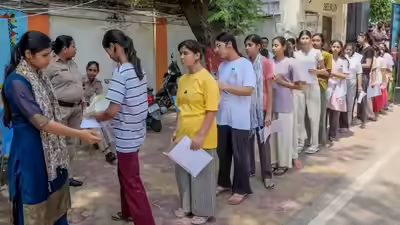
The National Testing Agency (NTA) is expected to release the UGC NET June 2026 admit card today on the official website, ugcnet.nta.nic.in.The hall tickets were expected to be issued on June 15, however, the admit cards were not released on the scheduled date, resulting in an unexpected delay. The University Grants Commission National Eligibility Test (UGC NET) June 2026 examination is scheduled to be conducted from June 22 to June 30. The examination determines eligibility for Assistant Professor posts, Junior Research Fellowship (JRF) and admission to PhD programmes.Ahead of the admit card release, NTA had already issued the city intimation slip for registered candidates.

The slip informs candidates about the city where their examination centre has been allotted, allowing them to make travel and accommodation arrangements in advance.Candidates should note that the city intimation slip is only meant to provide advance information and cannot be used for entry into the examination hall. Entry will be allowed only through the official admit card issued by NTA.Candidates are advised to carefully verify all details mentioned on the admit card after downloading it. Any discrepancy should be reported to the concerned authorities immediately.NTA has instructed candidates to carry a printed copy of the admit card along with a valid photo identity proof to the examination centre. Candidates who fail to produce the required documents may not be permitted to appear for the examination.

How to download UGC NET June 2026 admit card

Candidates can follow these steps once the hall ticket link is activated:

  • Visit the official website, ugcnet.nta.nic.in
  • Click on the UGC NET June 2026 admit card link on the homepage (News and events section)
  • Enter the application number and date of birth or password
  • Submit the details and log in
  • Download the admit card displayed on the screen
  • Verify all details carefully
  • Take a printout and keep it safe for examination day.

Source link

Re-NEET 2026: Temporary ban on Telegram imposed to prevent paper leak fraud ahead June 21 examination

Government restricts Telegram access and disables message editing to prevent NEET 2026 paper leak scams

Re-NEET 2026: The National Testing Agency (NTA) has welcomed government action to impose a temporary restriction on the Telegram platform in India ahead of the NEET (UG) 2026 re-examination scheduled for June 21, 2026. The move, taken under Section 69A of the Information Technology Act, 2000, aims to curb the misuse of the messaging platform by organised groups allegedly involved in spreading fake paper leak claims and defrauding aspirants.Alongside the access restriction, authorities have also directed Telegram to disable its message-editing feature in India for a limited period. The decision has been described as a calibrated, time-bound measure designed to prevent the circulation and fabrication of misleading “paper leak” evidence in the crucial examination window and immediate aftermath.Government Invokes IT Act To Act Against MisuseAccording to official inputs, the restriction has been imposed under Section 69A of the IT Act, which empowers the government to block public access to online content in the interest of sovereignty, integrity, public order, and security. The measure will remain in force only for a defined period ending June 22, 2026, covering the examination day and its immediate aftermath.Officials stated that the decision was taken after repeated instances of Telegram channels being used to circulate fraudulent claims of leaked question papers, particularly targeting NEET aspirants. These channels allegedly demanded money from candidates in exchange for fake access to examination material.

Crackdown On Fraudulent Telegram NetworksOver the past few weeks, multiple Telegram groups and channels with names such as “PAPER LEAKED NEET”, “Re-NEET 2026”, and similar variants were found to be actively engaging in scams. These groups reportedly attempted to exploit students and parents by promising access to examination papers in exchange for large sums of money.Enforcement agencies, including the Indian Cyber Crime Coordination Centre (I4C), have been coordinating with state police forces to identify and remove such channels. Authorities have also arrested members of cyber-fraud networks in several states, with investigations revealing large-scale financial transactions linked to these scams.Officials said that continuous monitoring and coordinated takedown efforts have already led to the removal of several fraudulent channels, but platform-level action was necessary to address the scale and speed of misinformation spread.Why Telegram Message Editing Was RestrictedIn addition to restricting access, the government has directed Telegram to disable its message-editing feature in India temporarily. Officials explained that this feature had been misused in past instances to fabricate “after-the-event” evidence of paper leaks.In such cases, administrators reportedly edited old messages after examinations were completed and inserted question papers or documents, making it appear as though the material had been circulated before the exam.

These manipulated posts were then widely shared to create false narratives of examination malpractice.The restriction aims to close this loophole during the sensitive examination period and prevent the creation of misleading digital evidence that could undermine public trust in the examination process.Assurance To Candidates And AdvisoryThe NTA has reassured candidates that the NEET (UG) 2026 re-examination will be conducted in a secure and fair manner. It clarified that the measures taken are intended solely to protect students from fraud and misinformation networks operating online.Authorities have urged aspirants and parents to remain vigilant against fake claims circulating on social media and messaging platforms. Students have been advised to rely only on official updates from the NTA website and verified communication channels.Candidates encountering suspicious offers or fraud attempts have been encouraged to report them immediately to the National Cyber Crime Helpline (1930) or the National Cyber Crime Reporting Portal.

Source link

UPSC Prelims Result 2026: Five mistakes qualified candidates should avoid before Mains

UPSC Prelims Result 2026: Common mistakes qualified candidates must avoid after clearing the first hurdle

NEW DELHI: Clearing the UPSC Civil Services Preliminary Examination is a major milestone, but experienced candidates and mentors often caution that it is only the beginning of a much longer journey. With the Union Public Service Commission (UPSC) declaring the Civil Services Preliminary Examination 2026 results and shortlisting 13,343 candidates for the Main Examination, aspirants now have just over two months to prepare for the next stage.At this critical juncture, even small administrative oversights or strategic mistakes can prove costly. As candidates shift their focus from objective-type questions to the descriptive Mains examination, experts advise avoiding a few common errors that frequently derail preparation.Ignoring the mandatory application windowOne of the most serious mistakes candidates can make is assuming that clearing the Preliminary Examination automatically guarantees entry into the Mains stage.

UPSC has opened a mandatory online window from June 19 to June 28, 2026, during which qualified candidates must complete several formalities, including fee payment, verification of personal details, and submission of cadre preferences. Candidates who fail to complete the process within the stipulated timeline will not receive their e-Admit Cards for the Main Examination.Even candidates who do not need to update any information are required to log in and submit their application forms.• UPSC CSE and IFS prelims results 2026 out; over 14,000 candidates qualify for mains examinationsUPSC Prelims result 2026 : Why fewer candidates made it to the Mains this yearUPSC Prelims 2026 Result Out: What happens next? Key dates, Mains process and important detailsDirect link to check and download the UPSC Indian Forest Service Preliminary result 2026Direct link to check and download the UPSC Civil Services Prelimis result 2026Delaying Mains preparationAnother common mistake is waiting for the Preliminary Examination result before beginning Mains preparation. Given the relatively short gap between the declaration of results and the commencement of the Main Examination on August 21, candidates have limited time to cover the extensive syllabus.The Main Examination requires a completely different approach, focusing on answer writing, analytical thinking and structured presentation of ideas. Aspirants who continue revising only Preliminary-level content often struggle to adapt to the demands of descriptive papers.Neglecting answer-writing practiceMany candidates devote substantial time to reading and note-making but postpone answer-writing practice. However,

UPSC Mains is as much a test of expression and time management as it is of knowledge.Experts recommend beginning daily answer-writing exercises immediately, particularly for General Studies and Essay papers. Developing the ability to write concise, well-structured answers within strict time limits can significantly influence performance.Overlooking optional subjectsOptional subjects account for 500 marks in the Main Examination and often play a decisive role in final rankings. Yet many candidates focus disproportionately on General Studies while neglecting revision of their optional papers.With the examination less than three months away, balanced preparation across all papers becomes crucial.Losing focus on the bigger picturePerhaps the biggest mistake is treating the Preliminary result as the final achievement. The Civil Services Examination remains a three-stage process, with the Main Examination and Personality Test still ahead.For the 13,343 candidates who have cleared Prelims this year, the challenge now shifts from qualifying to competing. Success in the next stage will depend not only on knowledge but also on planning, consistency and avoiding preventable errors during the crucial weeks ahead.

Source link

UPSC Prelims Result 2026 PDF Download: 13,343 candidates qualify for Civil Services Mains, check roll number list and next steps


UPSC Prelims Result 2026 PDF Download: 13,343 candidates qualify for Civil Services Mains, check roll number list and next steps
UPSC CSE Prelims 2026 result out in PDF format: Download list, check next steps and Mains dates

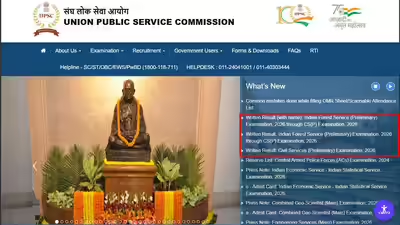
NEW DELHI: The Union Public Service Commission (UPSC) has released the Civil Services Preliminary Examination (CSE) 2026 result in PDF format on its official website. Candidates who appeared for the examination held on May 24, 2026, can now download the result PDF and check their roll numbers to confirm qualification status for the Civil Services Main Examination.This year, 13,343 candidates have qualified for the Civil Services (Main) Examination 2026 against 1,016 vacancies notified by the Commission. The candidature of shortlisted candidates remains provisional and subject to fulfilment of eligibility conditions prescribed under UPSC rules.UPSC Prelims Result 2026 PDF: How to downloadThe Commission has published the result in a roll number-wise PDF list. Candidates can check their status by downloading the file from the official UPSC website.To access the result PDF:Step 1: Visit the official UPSC website – https://www.upsc.gov.in/Step 2: Open the Civil Services Preliminary Examination 2026 result linkStep 3: Download the PDF file containing qualified candidates’ roll numbersStep 4: Use the search option (Ctrl+F) to locate your roll numberStep 5: Save the PDF for future referenceCandidates whose roll numbers appear in the list are eligible to appear for the next stage, the Civil Services Main Examination.Direct link to check and download the UPSC Indian Forest Service Preliminary result 2026Direct link to check and download the UPSC Civil Services Prelimis result 2026UPSC CSE and IFS prelims results 2026 out; over 14,000 candidates qualify for mains examinationsUPSC Prelims result 2026 : Why fewer candidates made it to the Mains this yearUPSC Prelims 2026 Result Out: What happens next? Key dates, Mains process and important detailsWhat happens after qualifying Prelims?UPSC has announced a mandatory online application process for all shortlisted candidates, which will be active from June 19 to June 28, 2026. During this period, candidates must complete fee payment (where applicable), verify personal details, update scribe and assistive device information if required, and submit cadre preferences.Even candidates who do not wish to make any changes must log in and complete the final submission. Failure to do so will result in non-generation of the e-Admit Card for the Main Examination.Key dates for UPSC CSE 2026

Event
Date
Civil Services Prelims 2026 May 24, 2026
Prelims Result Declaration June 15, 2026
Mains Application Window Opens June 19, 2026
Mains Application Window Closes June 28, 2026
Civil Services Main Examination Begins August 21, 2026

What comes next in the UPSC journey?The Civil Services Main Examination is the second stage of the selection process and consists of nine descriptive papers, including essays, general studies, optional subjects and language papers. Candidates who qualify in the written Mains will proceed to the Personality Test, carrying 275 marks.The final merit list will be prepared based on marks obtained in the Mains examination and interview performance. UPSC has clarified that cut-off marks, answer keys and detailed scores will be released only after completion of the entire examination cycle.For now, attention shifts from checking the result PDF to preparing for the demanding Mains stage, which begins in just over two months.


Source link

UPSC Prelims result 2026 : Why fewer candidates made it to the Mains this year


UPSC Prelims result 2026 : Why fewer candidates made it to the Mains this year
UPSC Prelims result 2026 shows sharper competition as Mains shortlist shrinks

NEW DELHI: The Union Public Service Commission (UPSC) has announced the results of the Civil Services Preliminary Examination 2026, but beyond the list of successful candidates, the numbers tell a bigger story. Compared to last year, significantly fewer aspirants have been shortlisted for both the Civil Services and Indian Forest Service (IFoS) Main examinations, signalling a tighter selection process this year.A total of 13,343 candidates have qualified for the Civil Services (Main) Examination 2026, down from 14,161 candidates shortlisted last year. The decline is even more striking in the Indian Forest Service examination, where the number of shortlisted candidates has nearly halved—from 2,116 in 2025 to 1,046 in 2026.Direct link to check and download the UPSC Indian Forest Service Preliminary result 2026Direct link to check and download the UPSC Civil Services Prelimis result 2026The shrinking funnelEvery year, lakhs of aspirants appear for the UPSC Preliminary Examination, but only a small percentage progress to the Mains stage. This year, that funnel appears to have narrowed further.The Civil Services Examination 2026 has 1,016 vacancies, slightly lower than the 1,087 vacancies notified in 2025. Correspondingly, the number of candidates shortlisted for Mains has also reduced. However, the decline in the IFoS shortlist is far steeper. Against 80 vacancies this year, only 1,046 candidates have qualified for the Main Examination, compared with 2,116 candidates shortlisted against 150 vacancies last year.The trend has sparked discussions among aspirants and coaching experts about whether the cut-off may have risen or whether the Commission opted for a more selective screening process.Relief for some, fresh pressure for manyFor the 13,343 Civil Services aspirants who cleared the first hurdle, celebrations may be short-lived. UPSC has directed qualified candidates to complete the online Detailed Application Form process between June 19 and June 28. This includes fee payment, updating personal details, and indicating cadre preferences.The Commission has clarified that all qualified candidates must log in and submit their forms, even if no changes are required. Failure to do so will prevent the issuance of e-Admit Cards for the Main Examination.The toughest stage still lies aheadClearing Prelims is often considered one of the most unpredictable phases of the UPSC journey. Yet, the Main Examination remains the decisive battleground. With fewer candidates now in the race, competition is expected to intensify as aspirants prepare for the descriptive papers that ultimately determine who moves on to the personality test and final selection.For thousands of candidates, the result marks an achievement. But the numbers also serve as a reminder that the path to securing one of India’s most coveted government jobs has become narrower this year.


Source link

89% of students studying abroad are knocking on the doors of Indian employers: Is the work-abroad dream losing its shine?


89% of students studying abroad are knocking on the doors of Indian employers: Is the work-abroad dream losing its shine?
The long-held belief that studying abroad naturally leads to a career overseas is facing a reality check. Fresh insights from Student Circus reveal an 89% surge in engagement with India-based job opportunities among students abroad between 2023 and 2024. As global immigration pathways become more uncertain and India’s corporate landscape expands, many internationally educated Indians are reassessing where the best opportunities for growth, stability, and career advancement truly lie.

A plethora of young students in India grow up dreaming of studying abroad. And quite naturally, the aspiration does not stop there; it extends to the prospect of building a career overseas. The notion has long remained unchanged: fly out, study hard, secure a job abroad, and eventually settle down. That narrative still exists, but it is increasingly being challenged.A shift is becoming evident. The numbers are beginning to tell a different story. Between 2023 and 2024, engagement with India-based job opportunities surged by 89%, according to behavioural insights drawn from Student Circus, a student career platform.What makes this trend particularly noteworthy is not merely the spike, but its persistence. Even after the initial surge, interest in returning to India did not wane. Instead, it remained strong, signalling something deeper than a short-term reaction to global uncertainty.So, what is really happening here?

When the “Abroad Advantage” starts feeling less certain

For years, studying abroad was packaged in an embellishing manner with prospects of global employment. But, that certainty is now being tested.Across key study destinations, including the US, UK, Canada, and parts of Europe, immigration rules have tightened, post-study work routes have become more complex, and job markets have grown increasingly competitive for international graduates.What has happened exactly is not an outright rejection of staying abroad. But yes, a hesitation has creeped in the hearts of students. They are no longer following the rosy dream, but are able to see the thorns on the aisle.

The 89% jump that refuses to fade away

The sharp rise in interest toward India-based opportunities between 2023 and 2024 initially looked like a predictable response to external pressure—policy tightening abroad, uncertainty around visas, and job market saturation.But the data does not flatten out after that moment.Instead, engagement remains consistently strong even into the following year. That is where the story becomes more interesting.Because behavioural spikes usually correct themselves. This one did not. It stabilised.Which suggests that internationally educated Indian students are not just reacting to constraints abroad, they are actively re-evaluating India as a viable, competitive career destination.

India is no longer the “Plan B” in the room

What is more promising is not just the return of interest, but the range of opportunities attracting attention. From high-growth startups and consulting firms to financial institutions and large Indian conglomerates, the interest map is wide and ambitious. There is no single “fallback sector” narrative here.Consulting, analyst roles, and business-focused careers continue to dominate attention patterns, pointing to something important: Expectations are not shrinking, they are shifting location.India, in this sense, is no longer being viewed as an alternative. It is being viewed as an ecosystem where global education can be deployed quickly and visibly.

The definition of success abroad has changed

There is an emotional undercurrent to the trend that numbers have failed to capture. For previous generations, “success abroad” was often tied to physical permanence. Staying overseas was itself the achievement.But for today’s students, success is becoming more outcome-driven than location-driven. Stability, career growth, leadership opportunities, and financial progression are weighing more heavily than geography alone.That is why the idea of returning, or considering India as the number one opportunity is no longer a compromise that students made earlier.

Not returning, but recalculating

In simpler terms, it can appear as a reversal of study-abroad dream. However, that dream is still alive and breathing. It is attracting students and shaping aspirations. Nonetheless, it has lost its absoluteness. What is emerging is a more pragmatic choice among Indian students studying abroad. India is no longer the end journey but slowly metamorphosing into the starting point.And this perhaps is the most pivotal shift of all.The question is no longer “Can I stay abroad?”But “Where will my career move fastest and with the least uncertainty?”And increasingly, India is no longer being ruled out of that answer.


Source link

NEET UG 2026 refund update: NTA warns against scams, offers another chance to correct bank details


NEET UG 2026 refund update: NTA warns against scams, offers another chance to correct bank details
NTA assures NEET UG 2026 candidates of secure refunds, announces post-exam correction window

NEET UG 2026 refund: The National Testing Agency (NTA) has issued an important update regarding fee refunds for NEET UG 2026 candidates, assuring aspirants that all eligible refunds will be transferred directly to the bank account details submitted and verified on the official examination portal.The clarification comes amid heightened attention on the refund process following recent reports of attempted cyber fraud targeting NEET candidates’ accounts. NTA has urged candidates to carefully verify their bank account information before downloading their admit cards to ensure that refunds are processed smoothly and without delays.According to the agency, candidates should log in to the official NEET portal using their application number and password or date of birth and review details such as the account number, IFSC code, and account holder name under the Bank Account Verification section. Any discrepancy in the submitted information could delay the refund process.The agency emphasized that refunds will be credited only to the bank accounts registered and verified by candidates on the official portal.Candidates who made errors will get another opportunity after the examAddressing concerns raised by several candidates regarding incorrect bank details or difficulties in completing the verification process, NTA announced that students who were unable to update their information or inadvertently submitted incorrect details will receive another opportunity to make corrections after the examination.The move is expected to provide relief to candidates who have reported technical issues while accessing the verification portal or those worried about mistakes affecting their refund eligibility.“Those who are facing issues in updating bank details or filled incorrect information will get another chance after the examination to fill correct details,” the agency said.The assurance comes after numerous candidates took to social media in recent days seeking clarity on refund verification requirements and the consequences of missing or incorrectly completing the process.Officials indicated that the additional correction window is intended to ensure that genuine candidates do not lose their refund due to technical glitches or data entry errors.NTA warns candidates against refund-related scamsAlongside the refund update, NTA has issued a strong advisory warning candidates and parents against cyber fraud and phishing attempts related to the refund process.The agency cautioned students to remain vigilant against fraudulent calls, text messages, emails, social media messages, or links claiming to speed up, verify, or facilitate refunds. According to NTA, fraudsters may attempt to exploit candidates by posing as officials and seeking sensitive financial information.“NTA never asks for OTPs, passwords, UPI PINs, or any payment to process a refund,” the agency said, urging candidates not to share confidential banking or login credentials with anyone.Candidates have been advised to rely only on official platforms for NEET-related information and refund services. The agency reiterated that all refund-related updates should be accessed through the official NTA and NEET websites.For assistance, candidates can contact the NTA helpdesk through the official email and helpline channels. The agency has encouraged students facing verification or refund-related difficulties to seek support through these official avenues rather than relying on third-party sources.With the NEET UG 2026 examination approaching, NTA’s latest advisory aims to ensure a secure refund process while protecting candidates from emerging cyber threats and misinformation.


Source link

Nothing signs MoUs with IIT Roorkee and IISc-FSID to boost India’s deep-tech innovation ecosystem


Nothing signs MoUs with IIT Roorkee and IISc-FSID to boost India’s deep-tech innovation ecosystem
Partnerships announced at Bharat Innovates 2026 aim to strengthen academia-industry collaboration

London-based consumer technology company Nothing has signed two strategic Memoranda of Understanding (MoUs) with the Indian Institute of Technology Roorkee (IIT Roorkee) and the Foundation for Science, Innovation and Development (FSID), Indian Institute of Science (IISc), Bengaluru, to accelerate India’s deep-tech innovation ecosystem.The agreements were formalised during Bharat Innovates 2026 held in Nice, France, a global platform organised by the Ministry of Education, Government of India. The event showcases India’s emerging deep-tech startups and brings together international investors, policymakers, and research institutions ahead of the G7 Summit.The ceremony was attended by senior dignitaries including Union Commerce and Industry Minister Piyush Goyal, Principal Scientific Adviser Ajay Kumar Sood, and Harish Salve, Chairman of the Board of Governors at IIT Roorkee. The MoUs were signed by Nothing Co-founder and India President Akis Evangelidis alongside leadership from IIT Roorkee and IISc.Speaking on the development, Evangelidis said the future of innovation will depend on stronger collaboration between academia, startups, and industry. He noted that Nothing aims to contribute its global product-building experience to help students and researchers transform ideas into scalable technologies.Focus on mentorship, startups, and hands-on innovationUnder the partnership with Indian Institute of Technology Roorkee, Nothing will support innovation-focused initiatives including mentorship programmes, expert lectures, industry case studies, and knowledge-sharing sessions. The collaboration will focus on areas such as entrepreneurship, deep-tech innovation, product engineering, and electronic design.The partnership also includes plans for a jointly organised Industrial Design Challenge, aimed at giving students hands-on exposure to consumer technology design and real-world innovation processes. Officials said the initiative is designed to bridge the gap between academic learning and industry requirements.Meanwhile, the collaboration with Indian Institute of Science and its Foundation for Science, Innovation and Development (FSID) will focus on engaging with incubated startups. The programme will include mentorship, networking opportunities, startup support initiatives, and potential pilot or commercial collaborations.The partnership will also enable industry exposure for students and founders through guest lectures, training sessions, and possible visits to Nothing’s global facilities.Strengthening India’s deep-tech ecosystemAccording to both partners, the MoUs reflect a shared commitment to strengthening India’s innovation pipeline by connecting academia, startups, and global industry expertise. The initiative aims to accelerate research commercialisation and deepen entrepreneurial capabilities within India’s growing technology ecosystem.Officials said the collaboration is aligned with broader national efforts to position India as a global hub for deep-tech innovation and talent development. By combining academic excellence with industry experience, the initiative is expected to create pathways for students and startups to build globally competitive technologies.Founded in London, Nothing has positioned itself as a fast-growing consumer technology brand focused on design-led innovation in smartphones and audio products. The company stated that its engagement with Indian institutions reflects its long-term commitment to supporting emerging innovators in one of the world’s fastest-growing technology markets.


Source link